


Stay up to date with VisiUpdates
Thank you! Your submission has been received!
Oops! Something went wrong while submitting the form.
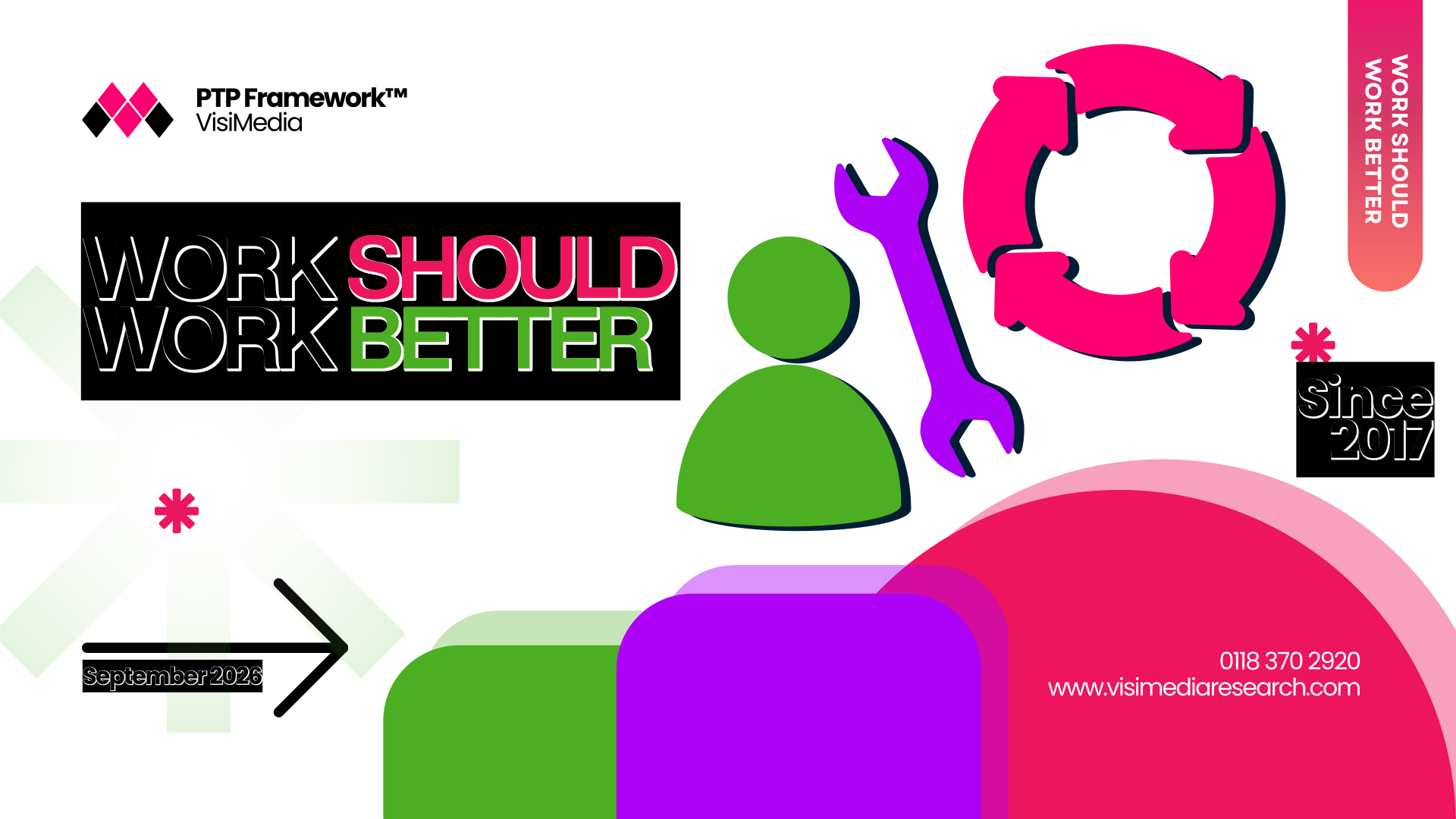
Work should work better
I have spent much of my career helping organisations change. I’ve introduced new systems, redesigned services, mapped processes (extensively!), supported adoption and helped to turn strategic intent into something that works on an ordinary Tuesday morning.
Across sectors, technologies and transformation programmes,I kept encountering the same pattern.
An organisation would describe a problem under the banner ofa “technology problem”. A new platform would be bought. A project would belaunched. Training would be delivered. Yet the promised improvementwould either arrive unevenly, disappear after implementation, or create anentirely new collection of workarounds.
Sometimes the tool was blamed. Sometimes the process wasblamed. Quite often, the people were blamed.
But the failure was rarely contained neatly within any oneof those things.
The technology might be capable, but poorly matched to thework. The process might look sensible on paper but ignore how decisions werereally made. The people might have the skills to succeed, but not theinformation, authority, confidence or time to use them. Each component couldappear reasonable in isolation while the overall system still producedfriction.
That was the realisation behind the PTP Framework:
Organisational capability is notsimply a property of its people, its tools or its processes. It emerges fromthe way the three work together.
People matter most
The first principle of the framework is deliberately human:people matter most.
Organisations have a habit of treating human behaviour asthe unpredictable part of the system. When a transformation stalls, we hearthat people are resistant, insufficiently engaged or reluctant to adopt the newway of working. There may be truth in those observations, but they are oftendescriptions of a symptom rather than explanations of a cause.
People make decisions according to the system around them.They respond to incentives, workload, trust, leadership, information, perceivedrisk and past experience. If a new tool makes their job harder, if a processconflicts with reality, or if speaking honestly carries a penalty, theirbehaviour is not an inconvenient variable. It is evidence.
That does not mean every performance problem is structural,nor that individual capability is irrelevant. It means we should stopdiagnosing people in isolation from the conditions in which they are beingasked to perform.
In a well-designed organisation, people are not obstacles tochange. They are the source of judgement, context, creativity and learning thatmakes useful change possible.
Tools enable people
The second principle is that tools should extend humancapability.
We have all seen the alternative: organisations accumulateplatforms, licences dashboards and increasingly token spend, while the workitself remains stubbornly difficult. Information is spread across systems.Teams re-enter the same data. The official process lives in one place and thereal process happens in email, spreadsheets and memory.
The more an organisation spends on tools, the easier it canbecome to see its problems through a technology lens. But buying a morepowerful tool does not automatically create better information, clearerownership or sounder decisions. Technology can accelerate a capable system; itcan also accelerate confusion.
This matters enormously as organisations adopt AI. AI is notmagic dust for untidy operations. It depends on people being able to identifyworthwhile uses, on information that can be accessed and trusted, and on rulesfor how outputs are checked and decisions are governed.
Recent UK Government research illustrates the point. Amongbusinesses surveyed, the most commonly reported barriers to AI adoption were afailure to identify a relevant use and limited AI skills; integration,regulation, data complexity and ethics also featured prominently. Amongbusinesses already using AI, limited skills remained the most commonly citedobstacle to wider adoption. The problem is plainly larger than access tosoftware. (UKGovernment AI Adoption Research)
The tool matters. But its value is realised through people,within a system of work.
Process enables work
The third principle is that process should help good workhappen repeatedly.
For many people, the word process conjures upbureaucracy: flowcharts, approval gates and documents that nobody has openedsince the consultant left. That is process badly understood.
A useful process provides clarity. It helps people know whatshould happen, who is responsible, what information is needed, where judgementis required and how an exception should be handled. It reduces avoidable effortwithout trying to remove human discretion from places where discretion addsvalue.
A poor process does the opposite. It leaves capable peopleusing good tools inside a system that still produces delay, duplication anderror. In those circumstances, people compensate. They build workarounds, carryknowledge in their heads and quietly perform the extra labour required to keepthe organisation functioning. Because the work continues, the underlyingweakness can remain invisible.
AI makes that weakness harder to ignore. Automating aprocess before understanding it can industrialise its defects. Giving an AIsystem access to fragmented or poorly governed information does not resolve thefragmentation. Asking people to use AI without clear ownership, boundaries orroutes for challenge creates uncertainty rather than capability.
This is why credible approaches to AI governance considerthe organisation around the technology. The US National Institute of Standardsand Technology, for example, frames AI risk management across the design,development, use and evaluation of AI systems—not as a question of modelselection alone. (NIST AI RiskManagement Framework)
From a simple model to a measurable framework
People, Tools and Process is an intentionally simple way toview an organisation. Simplicity is useful only if it helps us see somethingthat would otherwise remain hidden.
The PTP Framework is therefore concerned not only with thestrength of each pillar, but with the relationships and imbalances betweenthem.
An organisation may have highly capable people andsophisticated tools, but inconsistent processes. It may have disciplinedprocesses and sound technology, but a culture in which information does nottravel safely. It may score reasonably across all three at a high level while aparticular capability (such as learning, decision-making, data governance orcross-team communication) creates disproportionate friction.
Those differences matter. A single maturity score canconceal them.
Our working proposition is that performance depends not onlyon how strong People, Tools and Process appear separately, but on whether theyform a coherent system. The framework is being developed to make thatproposition measurable, comparable and open to challenge.
The initial PTP diagnostic examines 27 organisationalcapabilities through 50 questions. It is a theoretically specified diagnostic,not a finished scientific instrument. Its early weightings are hypotheses to betested against real responses, rather than conclusions dressed up asmathematics. That is precisely why we are beginning an experimental researchphase: to learn where the model explains organisational reality, where it needsrefinement and where it may be wrong.
Why PTP matters in an AI-ready world
AI has made the need for this kind of framework more urgent,but it did not create the underlying problem.
Organisations have always needed capable people, appropriatetools and workable processes. AI raises the stakes because it can operateacross all three: it changes the work people do, becomes part of the toolsetthrough which work is performed, and can execute or influence parts of theprocess itself.
That means “AI readiness” cannot sensibly be reduced towhether an organisation has purchased Copilot, formed a steering group or runprompt training.
An AI-ready organisation needs people who can exercisejudgement, question outputs and learn. It needs tools and informationarchitectures that are secure, usable and sufficiently connected. It needsprocesses that identify where AI adds value, define accountability and preservemeaningful human oversight.
Most importantly, those elements must reinforce one another.
The PTP approach allows us to examine the organisation as awhole and then apply a specific AI-readiness lens using the same underlyingstructure. The difference between those views may be especially revealing. Abusiness can be operationally capable today yet poorly positioned to transferthat capability into an AI-enabled environment. Another may have technicalenthusiasm but lack the governance or process discipline needed to scalesafely.
Readiness is not ownership of the newest tool. It is theability to use new capability deliberately, responsibly and productively.
The beginning of the research, not the end of the answer
The PTP Framework began as a practical response to arecurring problem: too many transformation efforts separate people, technologyand operations when the organisation experiences them as one system.
It has since grown into a wider research question. Can wemeasure that system meaningfully? Can imbalance help explain why similarorganisations experience very different outcomes from the same technology? Cana common framework help leaders see where investment will enable people, andwhere it will merely add another layer of machinery?
Those are testable questions, and they deserve evidencerather than slogans.
That is why we are establishing VisiMedia Research: ahome for the experimental work behind the framework, the findings that emergefrom it and the changes we make when the evidence challenges our assumptions.
Over the coming weeks, we will share more about the PTPmodel, our first experimental assessment and the research programme that willfollow at www.visimediaresearch.com.
Because work should work better. And if AI is going toreshape how organisations operate, we should understand the human systems intowhich we are introducing it.

As the MD at VisiMedia, I champion change management for organisations looking to develop rapidly. Whether its IT implementation, workforce engagement modernisation or process reengineering, my team and I are here to support your business.


Reach out to our team today or book a free consultation to see how we can help your business suceed
Call us on 0118 370 2920
Sales
sales@visimedia.co.uk
Technical Support
support@visimedia.co.uk
Or fill out our web form and we'll get right back to you
VisiMedia Ltd
4b Paddock Road
Reading
RG4 5BY
